

Beautiful Sunset Paintings: The Timeless Beauty of Light at the End of the Day
There are few moments in nature that feel as universal as sunset. It does not matter whether we are standing beside the sea, looking across a mountain valley, walking through a city or simply watching the sky from a window at home. For a few minutes, the ordinary world seems to change. Familiar buildings become silhouettes, water begins to reflect colors that were not there an hour earlier, and the sky can move through shades of gold, orange, pink, red, violet and deep blue before gradually becoming dark.
This fleeting transformation is one of the reasons sunset has fascinated artists for centuries. A sunset is beautiful in reality, but it is also remarkably difficult to capture in a painting because its appearance changes almost from one minute to the next. The artist is not simply painting a landscape. They are trying to preserve a particular atmosphere, a particular quality of light and, often, a particular feeling. This is what makes beautiful sunset paintings so appealing. They allow us to keep a moment that nature itself never allows us to hold for very long.
A sunset landscape painting can therefore be much more than a decorative landscape. It can suggest peace, freedom, nostalgia, romance or the anticipation of another day. Depending on the colors, composition and subject, the same setting sun can feel tranquil and intimate or dramatic and powerful. This emotional flexibility has made sunset one of the most enduring subjects in landscape painting.




Why Artists Have Always Been Drawn to Sunsets
Painters have long understood that light can completely transform a familiar landscape. A field that looks ordinary under the midday sun can become almost magical in the evening. A group of trees can turn into a dark silhouette against a glowing horizon, while the surface of a lake or ocean can become a long path of reflected gold.
The attraction is partly technical, but it is also emotional. Sunset creates an unusual relationship between light and shadow. Instead of illuminating everything evenly, the low position of the sun creates strong contrasts, revealing some elements of the landscape while allowing others to disappear into darkness. This gives the artist an opportunity to simplify the scene while making it more atmospheric.
During the Romantic period, painters became particularly interested in the emotional power of landscape. J.M.W. Turner became one of the great masters of atmospheric light, creating paintings in which the distinction between sky, water, land and air could almost disappear. In The Fighting Temeraire, for example, the sunset occupies an enormous part of the composition and becomes far more than a background detail. The National Gallery notes that the sunset was actually Turner’s invention rather than a strictly documentary representation of the scene, demonstrating how the artist used light to create meaning rather than simply record reality.
This idea remains important in sunset paintings today. The most memorable works are not necessarily the ones that reproduce a sunset with photographic accuracy. They are often the ones that communicate what it feels like to experience one.
The Extraordinary Colors of the Evening Sky
Perhaps the most obvious attraction of sunset paintings is color. Few other subjects offer artists such a naturally dramatic palette.
The familiar golden sunset begins with warm yellows and oranges, but as the sun moves closer to the horizon, the colors can become deeper and more complex. Reds may appear beside pinks, violet can emerge above the horizon, and blue gradually becomes more prominent as daylight disappears. Clouds can intensify the effect by catching the remaining sunlight and turning into glowing shapes against a darker sky.
For an artist, this creates almost endless possibilities. A realistic sunset may reproduce the subtle transitions between these colors, while an impressionistic painting might exaggerate them to communicate the sensation of light. An abstract artist can go even further, using the sunset as a starting point rather than a literal subject.
This is one reason sunset paintings work so well in contemporary interiors. Their colors can introduce warmth into a neutral room without requiring an entire decorating scheme to change. A painting dominated by gold and amber can make a minimalist interior feel warmer, while pink and violet tones can create a softer and more romantic atmosphere. Deep oranges and reds can add energy to a room that otherwise relies on white, grey or natural wood.
The sunset becomes a source of color that can influence everything around it.
From Turner to Impressionism
The history of sunset painting is also closely connected with the history of artists becoming increasingly interested in changing light. Turner was particularly important in this development. His later works often allowed atmosphere and luminosity to become more important than precise detail, creating landscapes that sometimes approach abstraction.
Eugène Boudin, who became an important precursor to Impressionism, was similarly fascinated by the sky. The Fitzwilliam Museum notes that Boudin became interested in painting sunsets in the 1850s and was celebrated by his contemporaries for his ability to capture skies. His Sunset on the Beach demonstrates how the sky and atmosphere can become the principal subject rather than simply a setting for people or objects.
The Impressionists took this interest in changing light even further. Instead of treating a landscape as something fixed, they explored how the same place could look completely different depending on the hour, weather and atmospheric conditions. A sunset therefore offered a perfect subject because it was constantly changing.
This way of seeing continues to influence modern painting. Contemporary sunset art does not have to follow the exact appearance of the landscape. The artist may simplify the horizon, exaggerate the colors or reduce the landscape to broad areas of light and shadow. What remains important is the experience of the moment.
Sunset Over the Sea
Among all the different types of sunset paintings, seascapes may be the most immediately evocative. There is something particularly powerful about seeing the sun disappear into an apparently endless horizon.
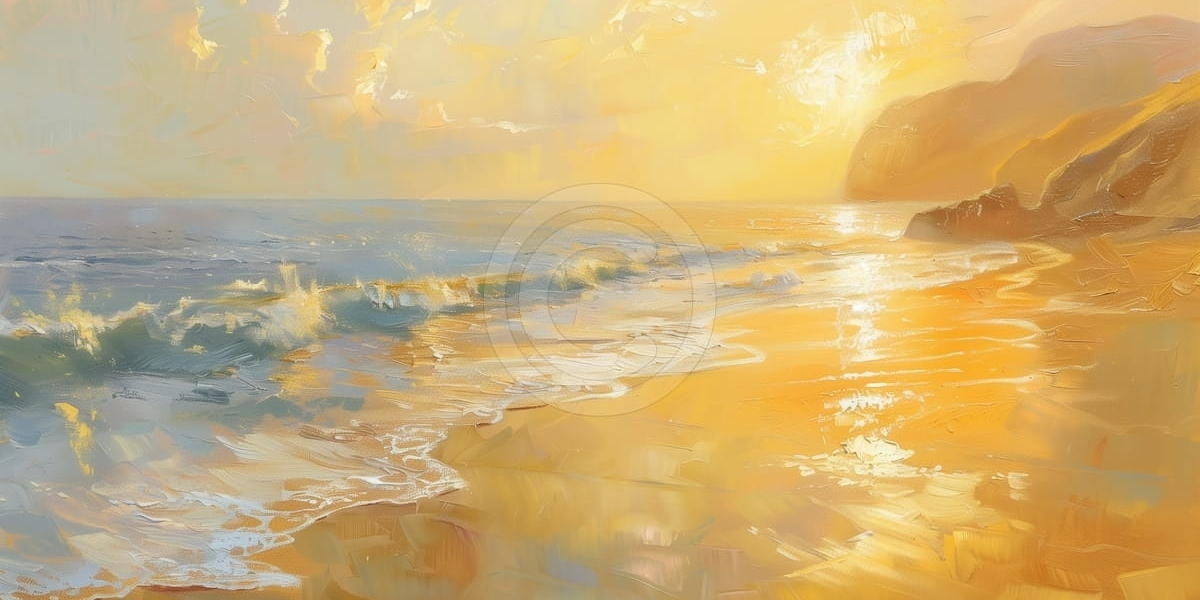
The relationship between sky and water gives the artist two surfaces on which to explore light. The colors of the sunset appear above the horizon and then return as reflections across the sea. Depending on the movement of the water, the reflection can be smooth and almost mirror-like or broken into hundreds of small fragments.
A peaceful ocean sunset can bring a remarkable sense of space to an interior. This is particularly useful in rooms where the artwork needs to create the impression of openness. A wide horizontal painting above a sofa, bed or console can visually extend the wall, while the distant horizon creates a feeling of depth.
There is also a psychological quality to these paintings. The ocean is associated with travel, freedom and distance, while the setting sun introduces a feeling of transition. Together, they can evoke the sensation of standing somewhere far from everyday life, even when the painting is hanging in a familiar room.
Sunset Landscapes and the Beauty of the Countryside
Not every sunset needs to end at the sea. Some of the most beautiful sunset paintings depict fields, forests, mountains, rivers or quiet rural roads.
A landscape at sunset has a different emotional character from a seascape. Trees and mountains create strong silhouettes, while fields and meadows can catch the last warm light of the day. A winding path disappearing into the distance can suggest a journey, while a small house illuminated by the final rays of sunlight can make the scene feel intimate and peaceful.
These paintings often work particularly well in living rooms, bedrooms and dining areas because they introduce nature without necessarily making the interior feel overly rustic. A contemporary landscape can combine the traditional subject of nature with modern color, simplified forms and expressive brushwork.
The result is artwork that feels connected to the natural world while still fitting comfortably into a contemporary home.
The Emotional Meaning of a Sunset
Part of the fascination with sunset comes from what it represents. Every sunset is an ending, but it is not necessarily a sad one. It can simply mark the transition from one part of the day to another.
This ambiguity gives artists considerable freedom. A golden sunset can suggest contentment after a long day. A dramatic red sky can create a feeling of intensity or anticipation. A quiet violet horizon can feel contemplative and almost dreamlike. A painting with a solitary figure watching the sun disappear may suggest nostalgia, while an empty beach can evoke freedom and solitude.
Because these interpretations are not fixed, viewers can bring their own experiences to the painting. Someone may associate a particular sunset with a holiday, a childhood memory, a place they once lived or a person they remember. Another viewer may see exactly the same painting simply as a beautiful landscape.
That personal quality is one of the reasons sunset artwork continues to be popular. The painting does not have to tell a specific story. It gives the viewer enough space to create one.
Beautiful Sunset Paintings in Modern Interiors
Although sunset paintings have a long history, they can feel remarkably contemporary when chosen carefully. The key is not necessarily to match the painting to a traditional decorating style, but to consider the atmosphere it creates.
A large sunset landscape can become the focal point of a living room, particularly when placed above a sofa or on a wide empty wall. Smaller sunset paintings can work beautifully in bedrooms, hallways or home offices, where their softer atmosphere can make the space feel more personal.
Color should also be considered. A room dominated by neutral furniture can benefit from the warmth of orange, gold and red. If the interior already contains strong colors, a sunset painting with softer pinks, blues and muted violets may create a more balanced effect.
Modern interpretations can be particularly versatile. Some paintings retain the recognizable horizon and landscape, while others reduce the scene to broad areas of color. In an abstract sunset, the viewer may recognize the familiar experience of evening light without seeing a literal beach, mountain or field.
This allows sunset artwork to fit into everything from traditional interiors to minimalist and contemporary spaces.
Choosing a Sunset Painting You Will Continue to Love
When choosing a sunset painting, it is tempting to focus only on the colors because they are usually the first thing that catches the eye. Yet the composition is just as important. Consider where the horizon sits, how much space is given to the sky, where the eye is drawn and whether there is a sense of depth within the landscape.
Think about the atmosphere you want the painting to create. A bright orange sunset can bring energy and warmth, while a quieter scene dominated by blue, lavender and soft gold can create a much more relaxing environment. A dramatic sky may become the main statement in the room, whereas a subtle landscape can quietly complement the existing decoration.
Size also matters. A wide sunset painting can make a strong statement above a sofa or bed, while a smaller artwork can become an intimate detail in a reading corner or office. In either case, it is usually better to give the painting enough surrounding space rather than filling every available part of the wall.
Most importantly, choose an image that continues to make you want to look at it. Trends change, but the emotional response you have to a beautiful sunset is much less likely to disappear.
The Sunset That Never Really Ends
Perhaps the greatest appeal of sunset paintings is that they preserve something that is inherently temporary. A real sunset lasts only a short time. The colors change, the light disappears and eventually the landscape becomes night.
A painting interrupts that process. It allows the golden light to remain on the wall long after the sun has disappeared outside. The same horizon can greet you every morning, even though it represents the final moments of another day.
That is what gives beautiful sunset paintings their particular charm. They are paintings about light, but also about memory, change and the quiet pleasure of stopping for a moment to appreciate something that cannot be held in real life. Whether expressed through a realistic seascape, an atmospheric countryside, an impressionistic sky or a contemporary abstract composition, the sunset remains one of nature's most enduring subjects.
And perhaps that is why, after centuries of painters returning to the same simple event, we still find ourselves stopping to look when the sky turns gold.