
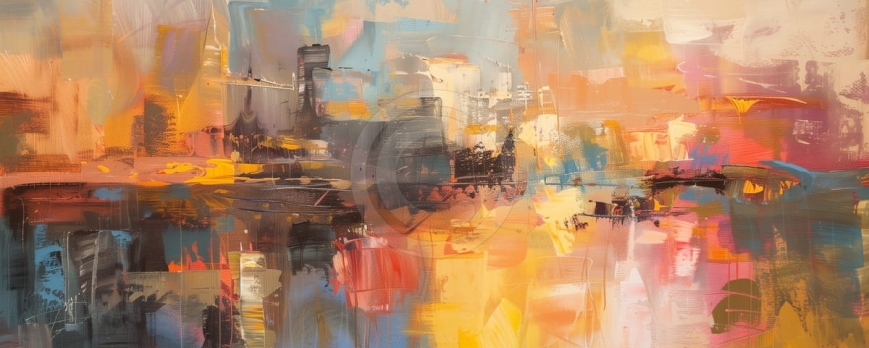
Modern Abstract Paintings: Art Beyond What We Can See
There are paintings that tell us exactly what we are looking at. We see a landscape and recognize the mountains, the trees and the sky. We see a portrait and immediately begin wondering about the person in front of us. Then there are paintings that do something completely different. They do not give us a clear subject or a familiar scene. Instead, they confront us with color, shape, movement and texture, leaving us to decide what we see and, perhaps more importantly, what we feel.
This is the world of modern abstract painting.
At first, abstract art can seem difficult because we are naturally accustomed to looking for recognizable things in a picture. We expect a painting to represent something: a person, a place, a flower, a building. When those familiar references disappear, it can feel as though there is nothing to hold onto. But that is precisely what makes abstract art so interesting. Instead of telling us what to see, it gives us the freedom to experience the painting for ourselves.
A modern abstract painting might remind one person of a landscape, another of movement or music, and someone else of nothing specific at all. None of these responses is necessarily wrong. The painting does not have to provide a single answer. Its meaning can change depending on who is looking at it, the mood of the room and even the time of day.


When Artists Stopped Trying to Copy the World
The idea behind abstract art did not appear suddenly. During the late nineteenth and early twentieth centuries, artists increasingly began questioning the traditional idea that painting should reproduce the visible world. Photography had already changed the role of realistic representation, while artists were becoming more interested in color, perception, emotion and the structure of a composition.
By the early twentieth century, several artists were taking this process much further. Vasily Kandinsky became one of the central figures in the development of abstraction, exploring the possibility that color and form could communicate feelings without depending on recognizable objects. His movement from figurative imagery toward increasingly abstract compositions was part of a much broader artistic transformation taking place across Europe.
Kandinsky was particularly fascinated by music because music could create powerful emotions without depicting anything recognizable. A piece of music does not need to represent a tree, a person or a sunset in order to make us feel something. He wondered whether painting could achieve something similar through color, line and form.
This was a radical idea at the time. A painting no longer needed to be a window onto the world. It could become its own world.
That change opened the way for generations of artists to explore what painting could do when it was freed from the obligation to describe reality.
The Language of Color and Form
When we look at a modern abstract painting, one of the first things we usually notice is color. Without a recognizable subject competing for our attention, color can become the main character of the composition.
A deep blue can create a feeling of calm or distance. A bright yellow can make a painting feel energetic and optimistic. Dark tones can introduce depth and drama, while pale neutrals can create a quieter and more sophisticated atmosphere. Sometimes a single strong color dominates the entire composition, while in other paintings dozens of subtle tones seem to overlap and interact.
But color is only part of the language.
Shapes can create a sense of order or movement. Straight lines may suggest structure and architecture, while curved forms can feel more organic and spontaneous. Large areas of empty space can make a composition feel calm, whereas dense layers of overlapping forms can create energy and tension.
Texture adds another dimension. Visible brushstrokes, rough surfaces and layered paint can make a work feel physical and expressive. Even in a reproduction, the suggestion of these textures can contribute to the impression that the artwork is something more than a flat image.
The interesting thing is that we respond to these elements almost instinctively. We may not know why a particular combination of shapes feels balanced or why one group of colors makes us feel more relaxed, but we recognize the effect.
Abstract art often communicates before we have had time to explain it to ourselves.
Why Abstract Art Does Not Need an Explanation
One of the most common questions people ask when looking at abstract art is, “What is it supposed to be?”
Sometimes there is a clear answer. The artist may have started with a landscape, a human figure, a city or another recognizable subject and gradually simplified it. In other cases, the painting may have been created without any particular object in mind. The artist may have been responding to color, movement, emotion or the physical process of painting itself.
But knowing the original intention is not always necessary to appreciate the work.
Imagine standing in front of a painting filled with broad blue and grey shapes. One person might see the sea. Another might think of clouds before a storm. Someone else might simply enjoy the cool, quiet relationship between the colors. The painting does not become less successful because these interpretations are different. In fact, its openness may be part of its strength.
This is one of the great differences between abstract and representational art. A realistic painting often gives the viewer a specific visual subject, while an abstract painting gives the viewer more room to participate.
We bring our own memories and emotions to it.
A particular shade of red might remind someone of autumn, while another person associates it with energy or warmth. A fragmented composition might feel chaotic to one viewer and exciting to another. The same painting can therefore change meaning without changing at all.
That makes abstract art unusually personal.
From the Gallery Wall to the Modern Home
Abstract paintings have also found a natural place in contemporary interiors because they do not depend on a particular historical setting or recognizable subject. A landscape might immediately establish a sense of place, and a portrait might introduce a very specific human presence. Abstract art can be more flexible.
A large geometric composition can complement the clean lines of a minimalist interior. A painting built around soft organic forms can introduce warmth into a room dominated by straight architectural shapes. Strong colors can become a focal point in an otherwise neutral space, while a restrained composition in beige, grey, cream or muted tones can quietly connect different elements of a room.
This flexibility is one reason abstract wall art works particularly well above sofas, beds, dining tables and large pieces of furniture. The painting can establish a visual center without dictating exactly what the room is supposed to represent.
There is also something refreshing about not having to match the artwork too literally with the rest of the décor. A painting does not have to contain the exact color of the curtains or cushions. Sometimes a contrasting color or unexpected shape is what gives an interior personality.
The best abstract artwork often creates a relationship with the room rather than simply blending into it.
The Difference Between Minimal and Expressive Abstraction
Not all modern abstract paintings create the same experience. Some are quiet, carefully balanced compositions in which a few shapes and colors seem to occupy their positions with almost architectural precision. Others are much more expressive, with energetic brushstrokes, overlapping colors and a sense of movement across the canvas.
Both approaches can be powerful, but they create very different atmospheres.
A minimalist abstract painting may be ideal for a room where the furniture and architecture already provide plenty of visual information. Its simplicity gives the eye a place to rest while still introducing an artistic element. On the other hand, an expressive abstract work can transform an otherwise restrained interior. It can provide the energy that a neutral room is missing and become the first thing visitors notice when they enter.
There are also paintings that exist somewhere between these extremes. Geometric structures may be combined with loose brushwork. Recognizable forms may appear beneath layers of abstraction. A landscape may be reduced almost entirely to blocks of color while still retaining a sense of horizon and distance.
This middle ground is particularly fascinating because it allows the viewer to move between recognition and imagination. You think you know what you are seeing, and then the painting changes the way you look at it.
Why We Keep Discovering Something New
One of the reasons people often become attached to abstract paintings is that they can remain interesting for a long time. A highly literal image may reveal most of its information immediately. You see the subject, understand the scene and move on.
Abstract art can work differently.
The first time you see it, you may notice the colors. A few days later, you may suddenly become aware of the balance between the shapes. After living with it for months, you may find yourself noticing a small detail in the corner that you had never really seen before.
Light can change the experience as well. Morning light may bring out subtle colors that seem less visible in the evening, while artificial lighting can make dark areas appear deeper and stronger. Because there is no single narrative that has to be understood, the painting can continue to offer different experiences.
This is particularly valuable when the artwork becomes part of your everyday environment. A painting hanging in your home is not viewed like a painting in a museum, where you spend a few minutes standing in front of it before moving to the next room. You pass it every day. You see it while drinking coffee, talking to friends or walking through the room without consciously looking at it.
Over time, it becomes part of the atmosphere of the space.
Choosing a Modern Abstract Painting for Your Space
Buying abstract art is perhaps more personal than buying almost any other type of wall art because there is no obvious subject to guide the decision. Instead of asking whether the painting accurately represents something you like, you have to pay attention to your reaction to the artwork itself.
Start with the atmosphere you want to create. If the room already feels busy, a composition with softer colors and more open space may bring balance. If the interior is dominated by neutral tones, a more colorful painting can introduce warmth and energy. In a minimalist room, geometric abstraction can reinforce the architectural character, while organic forms can soften an interior filled with straight lines.
Size matters too. Abstract art often benefits from being given enough space to breathe. A large canvas can allow the composition to become part of the architecture of the room rather than looking like a small decoration attached to an empty wall. Smaller works can be more intimate and work particularly well in bedrooms, hallways or smaller spaces.
Most importantly, choose an artwork that continues to interest you after the first impression. Trends come and go, but a painting that makes you pause every time you see it has much greater staying power.
Bringing Abstract Art Into Everyday Life
Modern abstract painting has come a long way from the moment when artists first questioned whether a painting needed to represent the visible world. What began as a radical challenge to traditional ideas about art has become one of the most versatile forms of contemporary wall art.
Today, abstraction can be geometric or organic, quiet or energetic, colorful or restrained. It can suggest a landscape without depicting one, evoke movement without showing anything moving, or create an emotional response without telling a recognizable story. The possibilities are almost unlimited because the artist is no longer restricted to the shapes and colors found in nature.
At PastelBrush, the Modern Abstract paintings collection brings together contemporary interpretations of abstraction, including geometric compositions, expressive works, flowing forms and paintings that move between abstraction and recognizable subjects. The collection is reproduced as premium giclée canvas wall art, allowing these contemporary compositions to become part of modern living spaces.
Perhaps the greatest appeal of abstract art is that it does not tell us exactly what to think. It gives us something to look at and leaves enough space for our own imagination to enter the picture.
And that may be why an abstract painting can remain on a wall for years without becoming boring. We do not finish it in the same way that we finish reading a story. We return to it, sometimes consciously and sometimes without realizing it, and each time we may notice something slightly different.
The painting remains unchanged.
We are the ones who change.