
Modern Abstract Art for Living Room: Why Canvas Art Prints Are Redefining Contemporary Interiors
Walk into almost any well-designed living room today and you'll notice something: the art on the walls rarely tells a literal story anymore. Instead of a vase of flowers rendered with photographic precision or a pastoral scene copied stroke for stroke from a 19th-century master, you'll find color, shape, gesture, and atmosphere doing the talking. This is the quiet revolution of modern abstract art for living room spaces — a shift away from representation and toward feeling, structure, and mood. And it's not a passing trend. It's a fundamental change in how people think about the relationship between art and the spaces they actually live in.
This article explores why modern abstract wall art has become the default choice for contemporary interiors, how to choose the right piece for your specific living room, and what makes canvas art prints — as opposed to original paintings, posters, or framed photography — the medium of choice for this particular aesthetic.


Why Abstraction Fits the Modern Living Room So Well
Living rooms have changed. Open floor plans, minimal furniture silhouettes, neutral palettes, and an emphasis on light and texture have replaced the heavily layered, ornament-driven interiors of previous decades. In a room built around clean lines and restraint, a hyper-detailed landscape or a busy still life can feel like visual noise. Abstraction, on the other hand, breathes with the room rather than competing against it.
There's also a psychological dimension. Figurative art tells you what to see — a face, a tree, a boat on water — and once you've seen it, there's little left to discover. Abstract art works differently. A canvas built from overlapping shapes, gestural brushwork, or a single bold color field doesn't resolve into one fixed meaning. It shifts depending on the light in the room, the time of day, your mood, even where you're standing. That ambiguity is exactly why abstraction rewards long-term living with a piece in a way that a literal image often doesn't. You don't get bored of it, because it was never fully "decoded" in the first place.
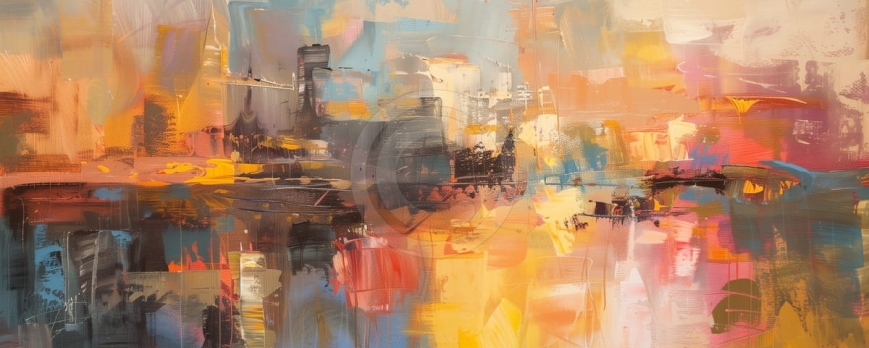
Consider a piece built around layered, atmospheric color — something like the kind of composition found in Abstract City Skyline, where dense, intersecting forms suggest an urban skyline without rendering a single recognizable building. From across the room it reads as mood and energy; up close it dissolves into pure texture and color relationships. That dual nature — legible at a distance, abstract up close — is one of the defining qualities of strong modern abstract wall art.
The Many Faces of Modern Abstraction
"Abstract" is a deceptively broad word, and one of the most common mistakes people make when shopping for living room art is treating it as a single style. In reality, modern abstraction spans several distinct visual languages, each suited to a different kind of room and a different kind of mood.
Geometric abstraction relies on hard edges, clean shapes, and structured compositions — think interlocking rectangles, circles, or grid-based patterns. This style pairs naturally with minimalist or Scandinavian-influenced living rooms, where furniture already favors simple forms and a restrained palette. A composition like Overlapping Forms, built from layered geometric shapes in muted tones, slots into this category neatly — it adds visual interest without introducing chaos.
Gestural or expressive abstraction, by contrast, is built on movement: visible brushstrokes, drips, splatters, and a sense that the artist's hand was working fast and instinctively. This style brings energy and unpredictability to a room and works particularly well as a focal point above a sofa or fireplace, where you want the eye drawn in immediately. Pieces with visible texture and motion — the kind of work that almost vibrates on the wall — fall into this camp.
Atmospheric or color-field abstraction strips things down even further, often relying on a small number of colors blended or layered to create depth and mood rather than form. These pieces tend to read almost like weather systems — fog, dusk, the way light changes color near a window. A piece such as Cathedral Interior, which uses architectural light and shadow in a semi-abstract way, sits at the intersection of atmosphere and structure, making it a flexible choice for rooms that need both calm and depth.
Symbolic or conceptual abstraction uses recognizable but simplified motifs — a circle split into two halves, a compass shape, balance and duality — to communicate an idea rather than depict a scene. This kind of work distills a concept into pure form and color contrast, demonstrating how abstraction can still carry meaning without ever becoming literal. These pieces tend to work well in rooms used for relaxation or reflection, since the underlying concept (balance, duality, calm) reinforces the function of the space.
Understanding these categories matters because the wrong type of abstraction in the wrong room can undercut the effect you're going for. A frantic, high-energy gestural piece in a room meant for quiet reading will fight the room's purpose. A muted color-field piece in a high-energy entertainment space might disappear entirely. Matching the abstraction's internal energy to the room's intended mood is the real skill in choosing modern abstract art for living room walls.
Why Canvas, Specifically
Once you've settled on a style, the next decision is medium — and this is where canvas art prints earn their dominant position over alternatives like framed paper prints, metal prints, or acrylic.
Canvas has texture. Even a printed reproduction retains a visible weave that catches light differently depending on the viewing angle, giving the piece a tactile, hand-made quality that flat paper or glass-faced prints simply can't replicate. For abstract work especially, where surface and texture often are the subject matter, this matters enormously. A gestural abstract piece printed on canvas preserves a sense of the original brushwork in a way that a glossy paper print flattens out.
Canvas is also forgiving of scale. Large abstract pieces — the kind that can anchor an entire wall — are lighter and easier to mount on canvas than on glass or metal, and they avoid the reflective glare that makes large framed prints hard to view from certain angles in a living room with windows. Gallery wrapping, where the canvas is stretched over a wooden frame with no visible border, lets the piece read as a continuous surface rather than a "picture in a box," which suits the boundary-dissolving nature of abstraction itself.
Finally, there's longevity and quality of reproduction. Giclée printing — a fine-art inkjet process using pigment-based inks on canvas — produces significantly richer color depth and tonal range than standard printing methods, with far less fading over time. For abstract pieces, where subtle gradients and layered color often carry most of the visual weight, this level of reproduction fidelity is the difference between a piece that looks flat and lifeless and one that genuinely reads as art rather than decoration.
Placement and Scale: Getting the Room Right
Even the best abstract piece will fail to land if it's hung wrong. A few practical principles make a significant difference.
Scale relative to furniture. A common mistake is choosing art that's too small for the wall it occupies. As a rule of thumb, a piece (or a grouped arrangement of pieces) above a sofa should span roughly two-thirds of the sofa's width. Undersized art over a large piece of furniture reads as an afterthought; oversized, confident pieces read as intentional design.
Eye-level centering. The vertical center of the artwork should sit roughly at eye level for someone standing — typically 57 to 60 inches from the floor to the center of the piece. This is the standard used in galleries for a reason: it's the height at which the human eye naturally rests, and it makes the piece feel anchored rather than floating awkwardly high or sitting too low.
Color relationship, not color matching. A frequent misconception is that abstract art needs to "match" the sofa or rug. It doesn't — and trying to match it usually flattens the piece into background decoration. Instead, look for complementary contrast: a warm, earthy abstract piece can sit beautifully against a cool gray sofa, creating tension that keeps the eye engaged rather than letting the room collapse into a single monochrome mood.
Lighting. Abstract pieces with subtle gradients or textured surfaces benefit enormously from directional lighting — a picture light or an angled ceiling spot that rakes across the canvas surface. This is particularly true for gestural or texture-heavy pieces, where raking light reveals brushwork and depth that flat, even lighting tends to erase.
Building a Cohesive Collection Rather Than a Single Statement
One trend worth noting in contemporary living room design is the move away from a single "hero" painting toward curated groupings — two or three abstract pieces from a related palette or stylistic family, arranged with intentional spacing rather than a rigid grid. This approach mirrors how art is often displayed in galleries: not as isolated objects but as a conversation between pieces. A geometric composition paired with a more atmospheric, color-field neighbor can create visual rhythm — structure on one side, calm on the other — in a way that a single painting, however strong, can't achieve alone.
This is also a practical argument for canvas art prints over original paintings: building a considered, multi-piece collection is financially realistic with high-quality reproductions in a way it rarely is with one-off originals, especially at the scale modern living rooms often call for.
Final Thoughts
Modern abstract art for living room spaces isn't a stylistic accident — it's a considered response to how interiors have evolved. Open, minimal, light-driven rooms need art that breathes with them rather than competing for attention, and abstraction, in its many forms — geometric, gestural, atmospheric, symbolic — does exactly that. Canvas, as a medium, amplifies this further: its texture, scale flexibility, and the depth achievable through giclée printing make it the natural carrier for abstract work that needs to feel present and tactile rather than flat and printed.
Whether you gravitate toward the structured calm of geometric form, the raw energy of gestural brushwork, or the quiet depth of color-field atmosphere, the underlying principle is the same: choose the abstraction whose internal energy matches what you want your room to feel like, scale it generously, light it well, and let it do the one thing good abstract art does better than almost any other genre — change, subtly, every time you look at it.
For anyone exploring options and wanting a sense of how these different categories — geometric, gestural, atmospheric, and symbolic abstraction — actually look when reproduced as gallery-quality canvas, browsing a dedicated modern abstract wall art collection is a useful way to see the range in practice before committing to a piece for your own space.