
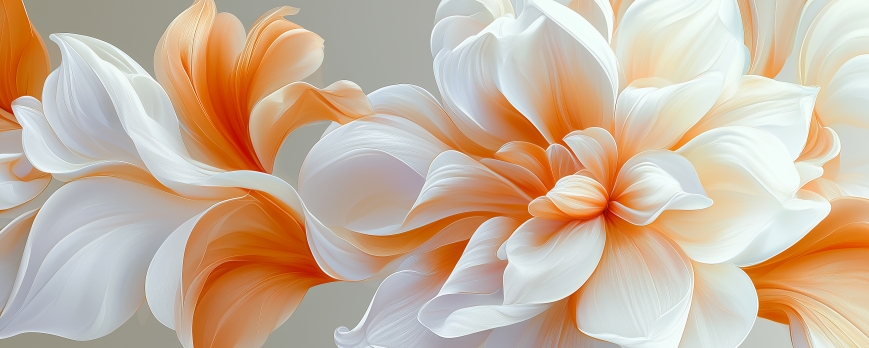
Modern Flower Paintings: When Flowers Become Art
There is something almost timeless about the way we look at flowers. We may pass hundreds of them without noticing, yet a single vase of fresh flowers on a table can change the atmosphere of an entire room. A garden in full bloom can make an ordinary afternoon feel special, while a single flower placed against a quiet background can suddenly seem almost monumental. Perhaps this is why flowers have remained one of the most enduring subjects in art. Artists have painted them for centuries, not simply because they are beautiful, but because flowers offer an extraordinary combination of color, form, fragility and emotion.
Modern flower paintings take this familiar subject and look at it from a different angle. The artist is no longer necessarily interested in showing every petal exactly as it appears in nature. Instead, the flower can become a starting point for exploring color, movement, shape and mood. A rose might be simplified until it becomes almost abstract, while a bouquet can be transformed into an explosion of color across the canvas. In some paintings, recognizable flowers remain at the center of the composition; in others, they are only suggested through sweeping brushstrokes, geometric forms or layers of color.
This freedom is what makes modern floral art so fascinating. It allows something as familiar as a flower to feel completely new.


From Botanical Beauty to Artistic Expression
For much of the history of Western art, flowers were painted with considerable attention to their physical appearance. In traditional still-life paintings, artists carefully observed petals, leaves, stems and vases, often creating compositions that were both beautiful and symbolic. Flowers could represent wealth, beauty, the passing of time or the temporary nature of life. A bouquet was never necessarily just a bouquet. It could contain an entire story hidden inside its colors and forms.
Modern artists gradually became less interested in this kind of visual accuracy. As painting changed during the nineteenth and twentieth centuries, artists began to ask different questions. What happens when color becomes more important than realism? What if the shape of a flower is exaggerated rather than faithfully reproduced? How much of the original subject can disappear before we stop recognizing it?
These questions opened the door to an entirely different kind of floral painting.
The flower could now be interpreted rather than copied. Its petals could become broad areas of color, its stem could become a line, and its natural symmetry could be replaced by an intentionally unbalanced composition. The artist could take the emotional impression created by a flower and translate that feeling onto the canvas without being restricted by botanical reality.
This is one of the defining qualities of modern flower paintings. They remind us that art does not always have to show us something exactly as it exists. Sometimes it is more interesting when the artist shows us how something feels.
The Flower as a Language of Color
Perhaps the most immediate difference between traditional floral painting and modern flower art is the role of color. In nature, flowers already provide an extraordinary palette, but modern artists are free to push those colors far beyond what we might encounter in a garden.
A bouquet of roses can become an arrangement of deep pinks, purples and reds, while a field of flowers might be reduced to a few bold tones that dominate the entire canvas. Yellow flowers can be placed against dark backgrounds to create a dramatic contrast, while pale whites and soft neutrals can create a much quieter and more sophisticated atmosphere. The flower itself may remain recognizable, but the colors begin to express something beyond the subject.
This is particularly interesting because color has a direct relationship with the way we experience a room. A large floral painting filled with strong reds and magentas can bring energy into a neutral interior, while a composition based on softer tones can create a feeling of calm. Blue flowers may introduce a cooler, more contemplative character, whereas warm yellows and oranges can make a space feel brighter and more welcoming.
In this sense, modern flower art is not only about depicting nature. It is also about creating an atmosphere around us.
That is one reason floral paintings work so naturally in contemporary interiors. They can connect the visual warmth of nature with the clean lines and simplicity of modern spaces.
When Flowers Become Almost Abstract
One of the most beautiful things about modern floral painting is the point at which the flower begins to disappear.
At first, we may recognize a rose, a poppy or a sunflower. We see the familiar shape and understand what the artist is showing us. But as we look longer, the individual details become less important. The petals may merge into broad areas of color, the outlines may become softer, and the background may begin to interact with the flowers rather than simply supporting them.
Eventually, the painting may no longer feel like an illustration of a flower at all. It becomes an abstract composition that happens to have grown from the idea of flowers.
This approach gives artists enormous freedom. A single flower can be enlarged until it fills most of the canvas, turning a delicate natural object into a powerful visual statement. Several flowers can overlap, creating layers that suggest movement and depth. Geometric shapes can be introduced behind the bouquet, creating a dialogue between organic forms and structured lines. Brushwork can remain visible, giving the painting a sense of movement and spontaneity.
The result is often more expressive than realistic. Instead of asking the viewer to admire the accuracy of the petals, the painting invites us to respond to its energy, rhythm and color.
That is where modern floral art becomes especially interesting. The subject may be familiar, but the experience of looking at it is not.
Why Flowers Work So Well in Modern Interiors
There is also a practical reason why modern flower paintings have remained so popular: flowers have an unusual ability to adapt to different interiors.
A contemporary living room with neutral walls and simple furniture can be transformed by a large floral composition. The painting introduces organic shapes into an environment dominated by straight lines and architectural forms. In a dining room, a colorful bouquet can create a warmer and more welcoming atmosphere, while a minimalist floral painting can work beautifully in a bedroom or quiet reading space.
The effect does not necessarily depend on the painting matching the furniture exactly. In fact, some of the most successful interiors use artwork to introduce contrast. A restrained room can become much more interesting when a bold floral canvas provides an unexpected burst of color. Likewise, an already colorful interior may benefit from a painting with softer tones that gives the eye somewhere to rest.
Scale matters too. A small floral painting can feel intimate, almost like a personal still life placed on the wall, while a large canvas can completely change the character of a room. Oversized flowers are particularly effective because they transform something delicate into something architectural. A flower that might normally fit in the palm of your hand can suddenly occupy an entire wall.
This is one of the pleasures of modern floral art: it allows nature to enter the interior without requiring a vase, a garden or even a window.
The Emotional Side of Modern Flower Paintings
Flowers also carry memories in a way that few other subjects can. Almost everyone has some personal association with them. Roses may remind us of someone we love, sunflowers of summer, tulips of spring, or wildflowers of a childhood landscape. Even when we cannot identify a particular memory, the colors and forms of flowers can evoke a feeling that is difficult to explain.
Modern painting takes advantage of this emotional quality without having to tell a specific story.
A painting filled with vivid flowers can suggest celebration and optimism, while a darker composition might feel more intimate and contemplative. A sparse arrangement of pale flowers can create a sense of elegance and quietness. An energetic abstract bouquet may suggest movement, growth and the feeling of a garden overflowing with life.
The viewer completes the painting in a way. The artist provides the colors, forms and gestures, but our own experiences determine what those elements mean to us.
This may be why floral art rarely feels completely unfamiliar. Even a highly stylized painting contains something we recognize. We know what a flower is, but we are free to decide what the particular flower in front of us represents.
Bringing the Garden Into Contemporary Art
The most compelling modern flower paintings do not try to compete with nature. They reinterpret it.
They take something that already possesses an almost perfect visual language and allow the artist to distort, simplify, exaggerate or reinvent it. A flower can become a splash of color, a geometric shape, a collection of expressive brushstrokes or an almost dreamlike composition. What remains important is not whether the painting looks exactly like a real flower, but whether it captures something of the experience of seeing one.
This is also why modern floral art can feel so fresh despite having such an old subject. Flowers themselves have not changed very much, but our ways of seeing them continue to evolve.
At PastelBrush, the collection of Modern Flower paintings brings together this contemporary approach in many different forms, from colorful bouquets and expressive blooms to minimalist compositions, geometric floral designs and abstract interpretations. These works are reproduced as museum-quality giclée prints on canvas, allowing the texture, color and character of the original artwork to become part of a contemporary interior.
Ultimately, perhaps the enduring attraction of modern flower paintings comes from their ability to combine two things that we never seem to tire of: the beauty of nature and the freedom of artistic expression. A flower may last only a few days in a vase, but on a canvas it can remain with us for years, changing slightly each time we look at it. The colors may remind us of a season, the composition may bring back a memory, or the simple presence of the painting may make a room feel more alive.
And perhaps that is the real magic of floral art. It does not merely bring flowers onto the wall. It brings with them a little of the feeling we have when we encounter beauty in nature — the feeling that, for a moment, an ordinary space has become something more.