
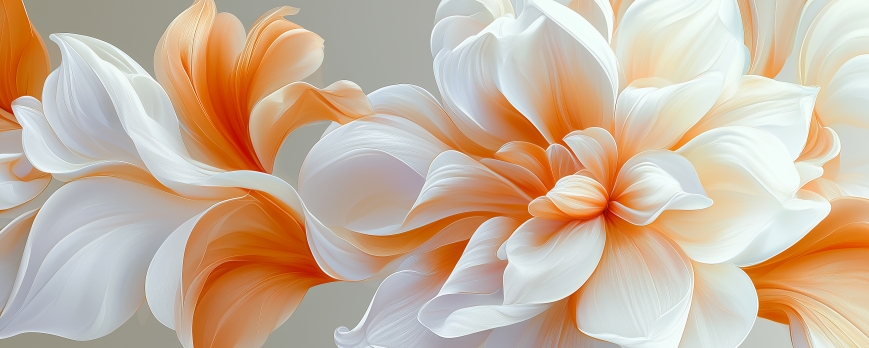
Modern Flower Wall Art for the Living Room: Why Floral Canvas Art Never Goes Out of Style
Flowers are probably the single most painted subject in the history of art, which raises an obvious question: why do they still feel fresh? The answer has nothing to do with the flower itself and everything to do with how each era chooses to render it. Modern flower wall art doesn't ask permission from botanical tradition the way a 17th-century still life would. It takes the flower as a starting point and pushes it — bolder color, freer brushwork, less interest in getting every petal right and more interest in impact. The result is floral canvas art that works in a contemporary living room the same way a classical still life once worked in a formal drawing room: as the defining visual statement of the space, just translated into a completely different visual language.
This article looks at what actually distinguishes modern floral wall art from its traditional counterpart, why it suits today's living rooms so naturally, and how to choose and place a canvas art print built around flowers in your own space.


Impact Over Accuracy
The clearest way to understand modern flower wall art is to see what it deliberately gives up. Traditional botanical illustration and classical still-life art prints prized accuracy above almost everything else — the correct number of petals, the believable translucency of a leaf, the precise way light pooled in a vase of water. Modern floral canvas art largely abandons that goal in favor of something more immediate: does the piece land the moment you look at it?
This shows up most clearly in oversized floral compositions, where a single bloom is blown up to fill the canvas edge to edge. A piece like Abstract Blue Flowers demonstrates this well — the flowers are rendered with loose, confident color rather than precise botanical detail, and the scale itself becomes part of the impact. You're not meant to identify the exact species; you're meant to feel the color and form first, with recognition as a secondary, almost incidental, response.
This is the core shift: where traditional floral art asked you to admire craftsmanship, modern floral wall art asks you to react to presence.
The Many Approaches to Modern Floral Art
Modern flower wall art isn't a single look — it spans several distinct approaches, each suited to a different living room mood.
Oversized, color-led blooms push scale and color saturation to the front, often cropping the flower so tightly that the composition reads almost like an abstract color study before it reads as a flower at all. These pieces work as genuine focal points and tend to suit living rooms that already lean modern and confident, since the piece itself carries enough visual weight to anchor a wall on its own.
Cubist and geometric floral compositions break the flower into facets and planes, borrowing the visual vocabulary of early 20th-century modernism. A piece like Cubist Rose Composition shows this clearly — the rose is still recognizable, but it's been fractured into overlapping geometric shapes and reassembled with a contemporary, almost architectural structure. This approach suits living rooms with a graphic, design-forward sensibility, where furniture and other decor already lean toward strong lines and intentional asymmetry.
Loose, expressive florals sit closer to traditional brushwork but trade precision for energy — visible strokes, drips, and a sense of motion that captures the feeling of a garden rather than a botanical inventory of it. These pieces tend to be warmer and more approachable than the geometric or oversized categories, and they work particularly well in living rooms that want floral wall art with movement and life rather than stillness.
Graphic and decorative floral patterns flatten the flower into bold line and solid color, closer in spirit to printmaking or textile design than to traditional floral art. A piece like Decorative Floral Composition illustrates this approach well — the floral motif is simplified into clean, repeatable shapes with confident color blocking, giving it a crisp, graphic quality that suits modern, minimalist living rooms especially well.
Choosing among these isn't really about which flower you like — it's about which visual register fits the room. A loosely painted bouquet and an oversized, color-saturated bloom will do very different work on the same wall, even though both are technically "modern flower wall art."
Why Floral Wall Art Reads as Warmth, Not Just Decoration
There's a reason floral wall art has stayed relevant across centuries of changing taste: flowers carry an almost universal emotional shorthand. They signal warmth, abundance, attention, and care in a way that's hard for other subjects to replicate — nobody sends a coastal landscape print to say "thinking of you." Modern floral canvas art inherits that emotional weight even while updating its visual language, which is part of why it remains one of the most requested categories of wall art for living rooms specifically, a room whose entire purpose is to feel welcoming.
This matters practically when choosing a piece, because it means a modern flower art print can do something a modern landscape or abstract piece often can't: introduce warmth and softness into a room without requiring the room to be traditional or fussy to support it. A boldly graphic floral composition can sit in an otherwise minimal, hard-edged living room and instantly soften it, simply because the subject matter itself carries that emotional association regardless of how contemporary its rendering is.
Canvas as the Right Medium for Floral Art Prints
The case for canvas art prints over framed paper or metal applies to floral wall art with a few genre-specific advantages worth noting.
Color saturation matters enormously for floral pieces, since so much of the genre's impact — especially in oversized, color-led compositions — depends on rich, accurate color reproduction. Giclée printing on canvas captures a far wider color gamut than standard printing methods, which matters specifically for the saturated reds, deep blues, and bright yellows that floral art relies on heavily; a flattened or color-shifted reproduction undercuts the entire point of a bold floral piece.
Texture also plays a real role, particularly for the loose, expressive style of floral wall art, where visible brushwork carries much of the emotional energy. Canvas preserves a sense of that brushwork in a way that a flat, glossy print cannot — the visible weave catches light and adds a tactile quality that echoes the texture of the original strokes.
Finally, scale flexibility matters for floral art in a specific way: an oversized bloom only works as intended at a genuinely large scale. A small print of a piece designed to read as monumental loses its entire point. Canvas handles large formats gracefully and affordably compared to glass-faced alternatives, making it the natural choice for floral pieces meant to make a real visual statement on a living room wall.
Placing Modern Flower Wall Art in the Living Room
Floral wall art tends to be more flexible in placement than landscape or abstract pieces, partly because flowers read as universally pleasant at almost any scale or position. Still, a few principles help maximize the effect.
Let oversized blooms stand alone. A large, color-saturated floral piece works best as a single statement rather than as part of a grouping — its whole appeal is scale and impact, both of which get diluted if it's surrounded by other pieces competing for attention.
Group looser, smaller florals. Expressive or still-life-style floral prints, by contrast, often work better in pairs or small groupings, echoing the way cut flowers are arranged rather than displayed as a single monumental specimen.
Consider the room's existing color temperature. Because floral wall art carries strong color associations — warm reds and yellows, cool blues, soft pastels — think about whether the piece should match the room's existing palette or intentionally introduce a contrasting accent. A boldly colored floral piece can function almost like a piece of furniture in terms of how much color it contributes to a room.
Use floral art to soften hard edges. In a living room with a lot of structured, geometric furniture, a graphic or loosely painted floral piece can introduce a counterpoint that keeps the room from feeling clinical, without requiring any other element of the decor to change.
Final Thoughts
Modern flower wall art proves that a subject doesn't need to be new to feel current — it only needs a new way of being seen. Whether you're drawn to the immediate impact of an oversized, color-led bloom, the structured reinvention of a cubist floral composition, the warmth of loosely painted bouquets, or the clean confidence of graphic floral patterns, the appeal is the same: flowers translated into a visual language that belongs to right now, carrying all the warmth of the subject with none of the formality that once came attached to it.
For anyone who wants to see this range in person — from oversized, color-saturated blooms to geometric reinventions of classic florals — browsing a dedicated modern flower wall art collection is a useful way to find the visual register that fits your own living room before choosing the piece that's right for your space.