
Cityscape Paintings: The Beauty of Cities Seen Through an Artist's Eyes
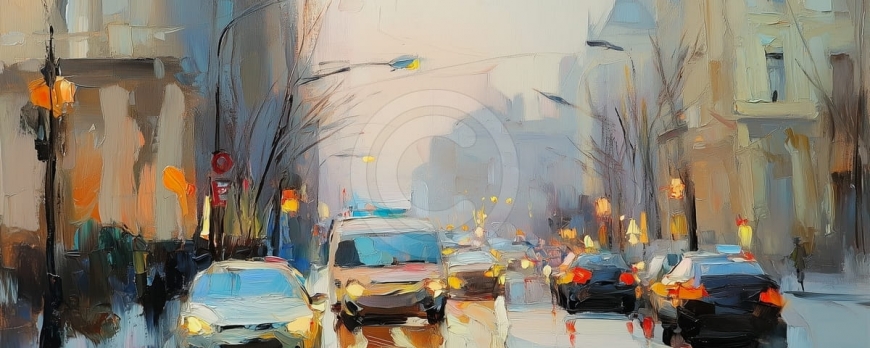
There are certain moments when a city seems to become more beautiful than it normally is. It might be early in the morning, when the streets are still quiet and the first sunlight touches the façades of old buildings. It might be just before sunset, when the windows of skyscrapers begin to reflect the changing sky, or on a rainy evening, when streetlights, shop windows and passing cars are transformed into long reflections across the wet pavement. We usually experience these moments without giving them much thought. We are on our way somewhere, thinking about work, dinner, an appointment or the many small things that fill an ordinary day. An artist, however, has the ability to stop and notice what everyone else is passing by.
This is perhaps the real fascination of a cityscape painting. It does not simply show us buildings, streets, bridges or squares; it captures the atmosphere that exists between them. A successful cityscape can make a familiar place feel new, or make a city we have never visited seem strangely familiar. It can remind us of a journey, suggest a story about people we will never meet, or simply recreate the particular feeling of standing in a city at a certain hour of the day.
For this reason, cityscape painting has always been about more than architecture. The buildings may provide the structure of the composition, but light, weather, movement and human presence are what give the city its personality.




When artists began to look at the city differently
For much of art history, cities appeared in paintings mainly as the setting for something else. A religious scene might take place in a town square, a historical event might unfold in front of an impressive palace, or a portrait might include an urban landscape in the background. Gradually, however, artists began to realize that the city itself could be worthy of attention.
One of the great early traditions of cityscape painting developed in Venice. The city's canals, bridges, palaces and remarkable relationship with water provided artists with an endless supply of subjects. During the eighteenth century, painters known as vedutisti became celebrated for their detailed views of Venice, many of which were created for travelers who wanted to take home a visual memory of the city.
These paintings could be remarkably precise, but their appeal did not come from architecture alone. Venice was a city made for painting because everything seemed to interact with everything else. Buildings were reflected in the water, boats moved between the palaces, sunlight changed the color of the stone and the atmosphere could transform the same street from one hour to the next. The city was never quite the same twice.
That idea would become increasingly important as artists began to move away from the simple recording of places and toward capturing the experience of being there.
The modern city comes alive
The nineteenth century brought enormous changes to European cities. Streets became wider and busier, new forms of transportation appeared, cafés and shops became important parts of urban life, and the growing use of artificial lighting gradually changed the way cities looked after sunset. For painters, this rapidly changing environment offered something that traditional landscapes could not: a subject that was constantly moving.
Paris became one of the most important cities in this transformation. Artists could step outside their studios and find a world filled with crowds, horse-drawn carriages, newly designed boulevards, cafés, theatres and shops. The modern city was no longer simply a collection of impressive buildings. It was a place of movement and social interaction.
The Impressionists were particularly interested in this new urban experience. Rather than concentrating exclusively on precise architectural details, they explored the effects of light, weather and movement. A boulevard could become a study of sunlight and shadow, while a rainy street could be transformed into a shimmering arrangement of reflections. Figures were often painted without detailed faces because their role was not necessarily to identify individual people, but to suggest the constant movement of urban life.
This changed the way cityscape paintings could communicate with the viewer. Instead of saying, "This is exactly what this street looks like," the artist could say, "This is what it feels like to stand here."
That distinction is important, because it remains at the heart of much cityscape art today.
The magic of the city at night
There is perhaps no time when a city becomes more painterly than after dark. Once the sun disappears, familiar streets are transformed by artificial light. Windows glow from inside buildings, streetlamps illuminate sidewalks, headlights move through traffic and signs create pools of color against the darkness.
For an artist, this creates an almost endless range of contrasts. Warm light can emerge from a restaurant on a cold evening, while the surrounding street remains dark and mysterious. A line of cars can become a trail of reflections across wet asphalt, and the windows of a skyscraper can resemble hundreds of tiny stars suspended above the city.
Nighttime cityscapes also tend to introduce a sense of mystery. During the day, we can usually understand a street immediately. At night, shadows hide details and familiar buildings can take on a completely different character. A quiet alley may feel romantic, while a busy avenue can seem almost cinematic.
This is one reason paintings of cities at night remain so popular. They are not simply representations of urban architecture; they capture the emotional atmosphere that appears when the city changes its personality after sunset.
Rain, reflections and atmosphere
Rain has a similar ability to transform an ordinary city into something extraordinary. Most of us associate rainy weather with inconvenience, but painters have long recognized how visually rich a wet city can become. Roads reflect buildings and lights, puddles mirror the movement of people, and distant architecture becomes softer as moisture fills the air.
The pavement itself becomes part of the composition.
Instead of looking only upward at buildings, the viewer's eye is drawn across the ground, following reflections that stretch beneath streetlights and passing cars. The distinction between the real city and its reflection becomes blurred, giving the painting a dreamlike quality.
This is especially effective when the artist does not attempt to describe every detail. A few expressive brushstrokes can suggest hundreds of illuminated windows, while broader areas of color can communicate the glow of a street without reproducing every individual object.
In such paintings, accuracy becomes less important than atmosphere. The artist is not necessarily asking us to identify a particular building; instead, we are invited to remember the feeling of walking through a city after rain, when everything appears brighter, quieter and somehow more distant.
When the skyline became a landscape
The rise of the modern skyscraper introduced another dramatic change to cityscape painting. In older cities, the skyline was dominated by church towers, domes and other relatively low structures. Modern cities began to grow vertically, creating entirely new perspectives.
New York became perhaps the ultimate example of this transformation. Seen from across the Hudson River, the city becomes a vast arrangement of towers and lights. Seen from street level, the skyscrapers create deep urban canyons, with buildings rising dramatically on either side of the viewer. From above, the city becomes almost abstract, with streets forming geometric patterns between blocks of architecture.
This is one of the reasons cityscape painting can move so naturally between realism and abstraction. At a certain distance, the details of a city disappear and what remains is a composition of lines, shapes, light and shadow.
An artist can therefore exaggerate the height of a building, simplify an entire skyline or intensify the colors of a sunset without necessarily losing the identity of the city. In some cases, these changes actually communicate the character of the place more effectively than a perfectly accurate representation could.
The painting becomes an interpretation rather than a document.
The small figures that bring a city to life
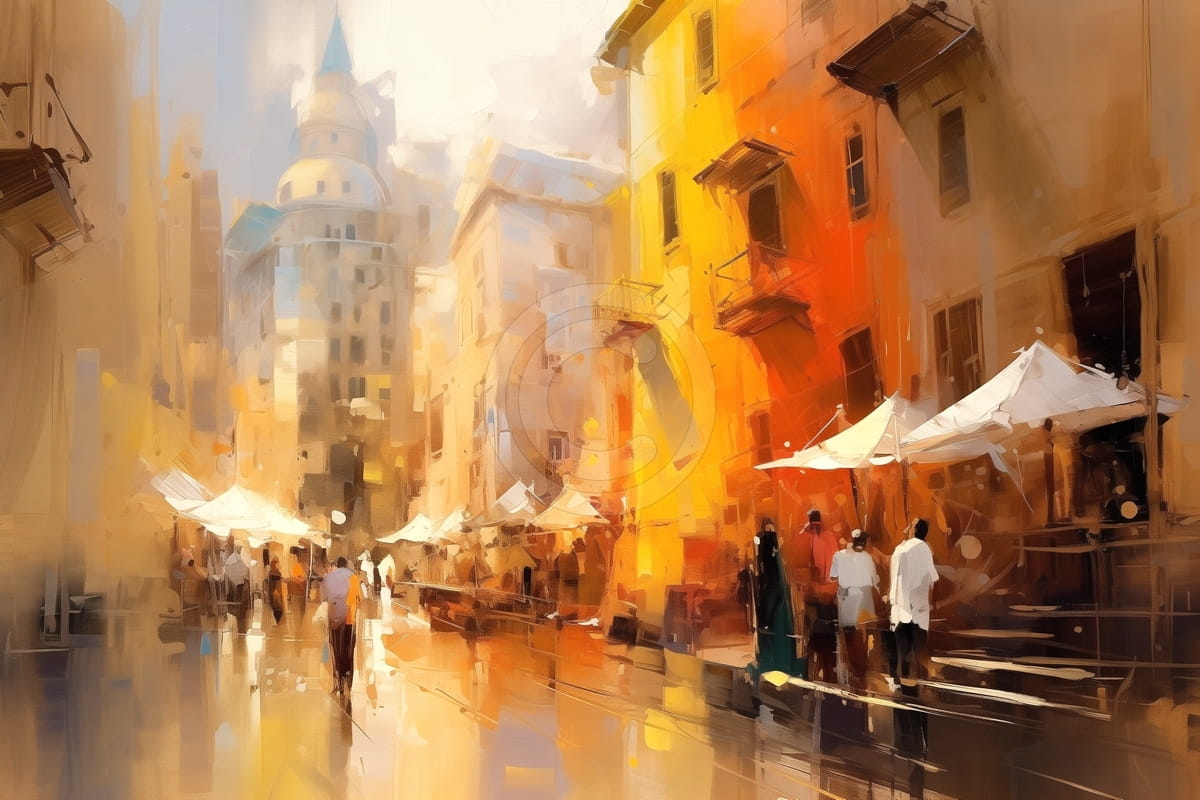
Architecture provides the framework of a cityscape, but people are often what make it feel alive. They may appear only as small figures walking across a square, waiting to cross a street, sitting outside a café or carrying umbrellas through the rain. Their faces are usually impossible to see, and their individual identities are not important.
What matters is their presence.
A nearly empty street with one person walking beneath a streetlamp can suggest solitude and quiet reflection, while a crowded boulevard filled with tiny figures immediately feels energetic and social. Because these people are not specific individuals, the viewer can easily imagine a place among them. We might picture ourselves walking through the same street on our way to a café, exploring an unfamiliar city during a holiday, or simply watching the evening unfold from a nearby window.
This is one of the subtle strengths of cityscape painting. The artist does not have to tell us who these people are or what they are doing. Their presence is enough to create the suggestion of a story, allowing the viewer's imagination to complete the scene.
The cityscape therefore becomes something more personal than a record of a particular location. It becomes a moment in which we can place ourselves.
Famous cities and imaginary journeys
Some cities have become almost visual symbols in their own right. Paris is associated with elegant boulevards, cafés and the Seine; Venice with canals, bridges and reflections; London with historic architecture, bridges and its distinctive atmosphere; New York with skyscrapers, busy streets and dramatic views of the skyline.
These recognizable characteristics make famous cities natural subjects for artists, but a good cityscape does not necessarily require a famous landmark. Sometimes an ordinary street can create a stronger emotional response precisely because it is anonymous.
A narrow European street at dusk, a row of old buildings illuminated by warm light or a small café on a rainy corner can suggest an entire city without identifying it. The viewer fills in the missing details from personal experience.
This is why cityscape paintings can make us nostalgic even when we have never actually visited the place shown. The painting may remind us of a journey we once took, a city we once lived in, or simply the romantic idea of wandering through a place that is unfamiliar.
Sometimes we are not remembering a real place at all. We are remembering a feeling.
The city as an artistic subject
Over time, artists have discovered countless ways to interpret urban landscapes. Some choose meticulous realism, carefully reproducing architecture and perspective. Others use loose, expressive brushwork to capture light and movement. Impressionist-inspired paintings may allow buildings to dissolve into color, while more contemporary approaches can reduce a skyline to geometric shapes or transform an ordinary street into something almost abstract.
None of these approaches is necessarily more correct than another, because a city is experienced in many different ways. It can be exciting or exhausting, familiar or mysterious, crowded or strangely lonely. The same street can feel completely different in the morning, during a summer afternoon or late at night.
Painting gives artists the freedom to choose which version of the city they want to preserve.
A photograph might capture one instant, but a painter can combine several impressions into one image. The light from sunset can coexist with the atmosphere of evening, or the movement of a crowded street can be emphasized even if the actual moment was relatively quiet. The artist is not simply recording what happened; the artist is constructing a memory.
That is perhaps why painted cities often feel more emotional than photographic ones.
Bringing the city into the home
Cityscape paintings also have a natural place in contemporary interiors because they connect the private world of the home with the energy of the outside world. A panoramic skyline can create a sense of openness, particularly in a room where a large architectural view becomes a visual focal point. A romantic European street can add warmth and character, while a dramatic nighttime cityscape can introduce a more sophisticated and energetic atmosphere.
The choice of city and mood can change the entire feeling of a room. Bright lights and vivid colors can create a sense of movement and excitement, while a muted street scene at dawn or dusk can feel much calmer. A painting of an old European neighborhood may suggest history and romance, whereas a modern skyline can bring a more contemporary architectural character to the space.
In this way, cityscape wall art does not merely depict a place. It helps establish the personality of the room in which it hangs.
The cities we remember
Perhaps the enduring appeal of cityscape paintings comes from the fact that cities are deeply connected with memory. We remember places through small details: the color of a building in the evening, the sound of traffic outside a hotel, the reflection of lights on a river, the café where we stopped during a journey or the street we walked down without knowing that the moment would later become a memory.
A painter can take those fleeting impressions and turn them into something permanent.
That is what makes a cityscape more than a picture of buildings. It preserves an atmosphere that would otherwise disappear as soon as the light changes, the rain stops or the people move on. The city continues to exist outside the painting, constantly changing and rebuilding itself, while the artwork holds one particular interpretation of it still.
If you are drawn to the atmosphere of historic streets, romantic European cities, dramatic skylines or glowing urban scenes, you can explore the Cityscape Paintings collection at PastelBrush and discover artwork designed to bring that sense of place into a contemporary interior.
A great cityscape does not ask us simply to recognize a building or identify a street. It asks us to pause and look at a city differently—to notice the light on the windows, the reflections beneath our feet, the people moving through the streets and the changing colors of the sky.
Because cities are never just made of buildings. They are made of moments, memories, journeys and countless stories happening at the same time.
And a cityscape painting gives us the rare opportunity to hold one of those moments still.