
Cityscape Wall Art for the Living Room: Why Urban Canvas Art Brings a Room to Life
A city is the most human landscape there is. Unlike a forest or a coastline, nothing about it occurred by accident — every street, every rooftop, every pool of lamplight was put there by intention, shaped by decades of ambition and decision. That's exactly why artists keep returning to it, and why cityscape wall art has become such a distinctive category of its own, separate from landscape art even though both technically depict the world outside a window. A city doesn't just sit there to be observed; it pulses, and a good cityscape canvas art print captures some of that pulse rather than just its outline.
This article looks at what makes cityscape wall art such a compelling category for the living room, the different visual approaches within it, and how to choose and place a canvas art print built around urban scenes in your own space.


Energy as the Real Subject
The most important thing to understand about cityscape wall art is that the city itself — the specific skyline, the named street, the recognizable landmark — is often secondary to something harder to pin down: atmosphere. A rain-slicked street under neon light, a sunset catching the upper floors of a tower, the particular electric quality of a city at night that never fully goes dark — these are the actual subjects, with the urban setting acting as the stage rather than the star.
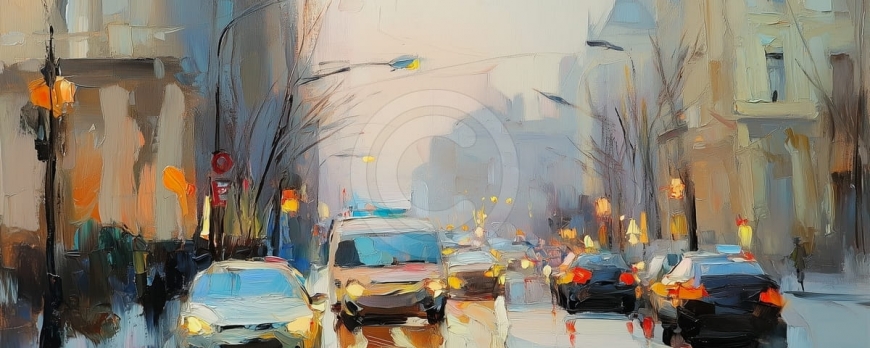
This is why cityscape art prints work so well as living room pieces even for people who've never visited the place depicted. A piece like Rainy City Lights doesn't require you to recognize the street to feel its mood — the wet pavement catching color, the blurred glow of passing light, the sense of motion and weather, all communicate something universal about urban evening atmosphere regardless of which city it happens to be. The energy is the subject; the geography is just where that energy happens to be staged.
The Different Visual Languages of Cityscape Art
Cityscape wall art spans a wider stylistic range than people often expect, and understanding the differences helps in choosing a piece that matches a specific living room mood.
Photographically precise modern cityscapes lean toward sharp detail and high contrast — rain-slicked streets reflecting neon, glass towers catching late light, scenes that feel almost cinematic in their crispness. These pieces work well as bold, contemporary focal points and suit living rooms with a sleek, design-forward sensibility, where the art itself functions almost like a window onto a high-energy urban moment.
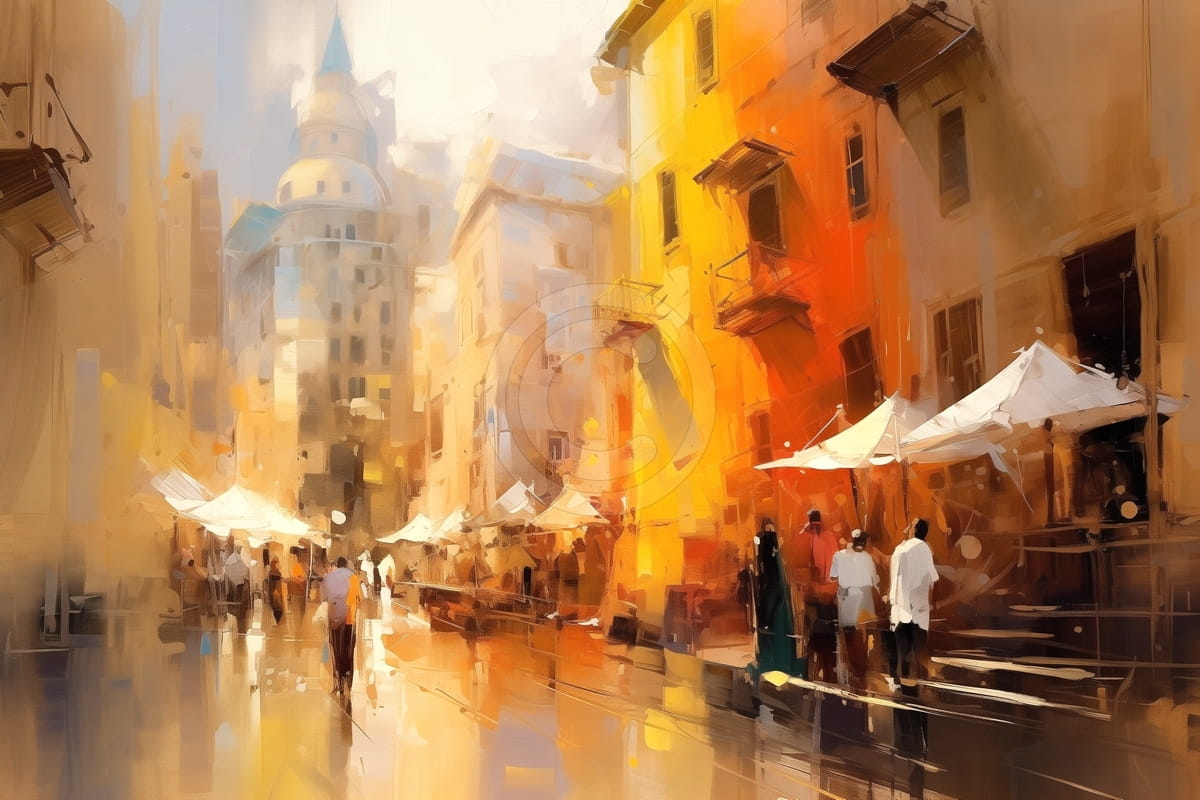
Impressionist cityscapes trade precision for atmosphere — loose brushwork, soft edges, a sense of movement and weather that matters more than architectural accuracy. A piece like Golden Skyline sits comfortably here, where a sunset-lit skyline is rendered with warm, blended color rather than crisp architectural lines, prioritizing the emotional temperature of dusk over a literal record of any particular building. These pieces tend to feel warmer and more approachable than their photographically sharp counterparts, and work well in living rooms that want urban energy without anything that reads as cold or clinical.
Abstract cityscape compositions push furthest from representation, dissolving buildings into vertical planes of color and light until the city becomes more of a rhythm than a recognizable place. These pieces suit living rooms that already lean toward abstract or minimalist decor, where a fully representational city scene might feel like too literal a statement.
Romantic and nostalgic cityscapes — canal scenes, lantern-lit terraces, narrow European streets — sit closer to travel memory than urban grit. A piece like Venetian Dream captures this register well, where soft light and water reflections create a mood that's more wistful than energetic. These pieces work especially well in living rooms designed around warmth, comfort, and a sense of escape, rather than urban dynamism.
Choosing among these isn't really about which city or landmark appeals to you — it's about whether you want the piece to inject energy into the room or soften it with warmth and nostalgia. The same living room could call for very different choices depending on whether it's meant to feel energizing or relaxing.
Why Cityscape Wall Art Works So Well in Living Rooms
Living rooms are, almost by definition, social spaces — rooms built around conversation, gathering, and activity. Cityscape wall art mirrors that energy in a way that's harder for quieter genres like landscape or still life to match. A city scene, even a calm one, carries an implicit sense of life happening just outside the frame: people walking somewhere, lights left on for a reason, a street that existed before the moment captured and continues after it. That implied motion gives a living room a kind of energy that a static, empty landscape often can't.
There's also a sophistication factor that cityscape art prints bring to a room without trying too hard. A well-chosen urban scene — particularly one rendered with painterly or impressionist looseness rather than postcard literalism — signals a worldly, design-conscious sensibility, which is part of why cityscape wall art has remained a perennial favorite for living rooms that want to feel curated rather than decorated.
Canvas as the Right Medium for Cityscape Art
The case for canvas art prints over framed paper or metal applies to cityscape wall art with a few advantages specific to the genre.
Color depth matters enormously for cityscapes, particularly night and rain scenes where saturated neon, warm lamplight, and cool wet pavement all need to read clearly against each other. Giclée printing on canvas reproduces that color range far more faithfully than standard printing, which is critical for a genre that depends so heavily on contrast between warm artificial light and cool ambient darkness.
Texture also plays a real role for impressionist and loosely rendered cityscapes, where visible brushwork carries much of the atmospheric quality. Canvas preserves that texture in a way flat paper cannot, letting the piece read as painterly rather than photographic even when the subject is an urban scene that could easily have been a photograph instead.
Finally, scale works in cityscape art's favor in a specific way: a large-format urban scene can function almost like an actual window, especially in apartments or living rooms without much of an outside view. Canvas handles that scale gracefully and affordably, making it the natural choice for cityscape pieces meant to anchor a living room wall.
Placing Cityscape Wall Art in the Living Room
Cityscape pieces have their own logic when it comes to placement, distinct from landscape or floral art.
Treat it like a window, not a portrait. Because cityscapes often function as an implied view, they work best hung at a height and scale that mimics an actual window — generously sized, positioned where the eye naturally rests, rather than small and high.
Match the scene's energy to the room's function. A high-contrast, photographically sharp night scene suits a living room used for entertaining and energy; a softer, impressionist or nostalgic cityscape suits one built around quiet evenings and conversation.
Let one piece do the talking. Cityscape wall art, especially bold or busy compositions, tends to work best as a single statement piece rather than grouped with other art — too much visual competition undercuts the immersive, window-like quality that makes the genre work.
Consider the room's existing light. A bright, naturally lit living room can support a moody night cityscape as a deliberate contrast, while a dimmer room often pairs better with a warm, sunset-toned urban scene that doesn't fight the room's existing light levels.
Final Thoughts
Cityscape wall art occupies a category of its own — not quite landscape, not quite abstraction, but something that captures the specific, restless energy of places built entirely by human intention. Whether you're drawn to the photographic sharpness of a rain-soaked street, the warm atmosphere of an impressionist skyline, the dissolved structure of an abstract urban composition, or the wistful glow of a canal at dusk, the appeal is the same: a city scene brings the implied life of somewhere else directly into the room, giving a living room an energy that quieter genres rarely match.
For anyone who wants to explore this range firsthand — from sharp, neon-lit streets to soft, sunset-toned skylines — browsing a dedicated cityscape wall art collection is a useful way to find the urban mood that fits your own living room before choosing the piece that's right for your space.