
Modern Landscape Wall Art for Living Room Spaces: How Contemporary Canvas Art Is Reinventing Our View of Nature
For most of art history, the landscape was a record. An artist stood in a field, by a coast, at the edge of a forest, and tried to set down what was actually there — the precise slope of a hill, the correct density of foliage, the exact way light fell across water at a given hour. Modern landscape wall art breaks with that obligation almost entirely. The world outside is still the subject — forests, coastlines, fields, horizons haven't gone anywhere — but the goal has shifted from documentation to interpretation. A modern landscape art print doesn't ask "is this accurate?" It asks "does this feel true?" And that single shift in priorities has changed what landscape canvas art looks like, what it does for a living room, and why people are choosing it over traditional, representational nature art in growing numbers.
This article looks at what actually defines modern landscape wall art as a genre, why it has become such a natural fit for the contemporary living room, and how to think about choosing and placing canvas art prints in your own space.



Reinterpretation, Not Abandonment
It's worth being precise about what "modern" means here, because the word gets used loosely. Modern landscape canvas art hasn't abandoned nature in favor of pure invention — that's abstraction's job. Instead, it keeps the recognizable subject (a forest, a shoreline, a mountain range) but frees the artist from the responsibility of reproducing it faithfully. What's left, once photographic accuracy is no longer the goal, is room to chase color, simplified form, and emotional truth — the things a camera, or a meticulous 19th-century landscape artist, would tend to miss or smooth over.
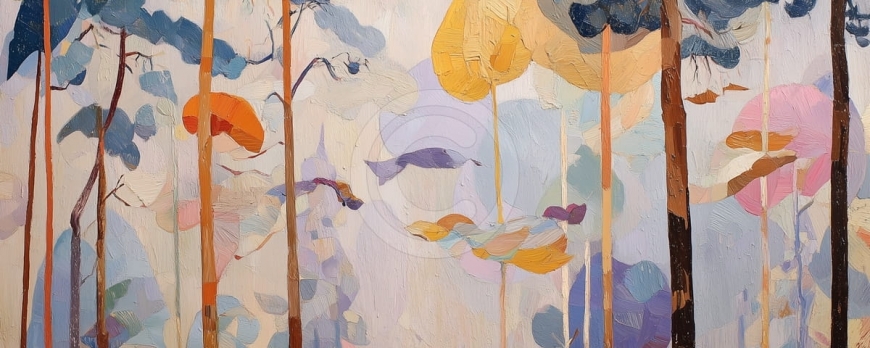
This is easiest to see in a piece like Pastel Forest, where a wooded scene is rendered not in the greens and browns a photograph would capture, but in a softened, almost dreamlike palette that prioritizes mood over botanical accuracy. The trees are still recognizably trees. The forest is still legible as a forest. But the color has been allowed to do something a literal rendering never would — and the result feels less like a record of a place and more like a record of how that place might feel to stand inside.
This is the core move of modern landscape wall art: keep just enough of the recognizable world to anchor the viewer, then use everything else — color, brushwork, simplification, scale — to say something a strictly accurate version couldn't.
Why Modern Landscape Wall Art Fits the Modern Living Room So Well
Living rooms have changed in much the same way abstract canvas art's popularity reflects. Open floor plans, neutral palettes, and furniture built around clean lines have replaced the heavily layered interiors of previous decades — and against that backdrop, a meticulously detailed, traditionally rendered landscape print can feel oddly busy, even old-fashioned. Modern landscape wall art, by contrast, brings the warmth and familiarity of nature into the room without the visual clutter that strict realism tends to carry with it.
There's also a comfort factor that distinguishes landscape art prints from pure abstraction, and it's worth being honest about it. Not everyone wants a living room built entirely around ambiguous color fields and gestural brushwork — many people want wall art that still reads, at a glance, as a place: a forest, a coastline, a field at sunset. Modern landscape canvas art offers a middle path. It gives a living room the legibility and warmth of a recognizable scene while still feeling current, painterly, and intentional rather than decorative in a generic, hotel-lobby sense. This is precisely why it has become one of the most requested categories of wall art for living room spaces — it satisfies both the desire for something easy to live with and the desire for something that still feels like art rather than wallpaper.
The Spectrum: From Loose Realism to Near-Abstraction
Like abstract canvas art, modern landscape wall art isn't one style but a spectrum, and understanding where a piece sits on that spectrum helps enormously when choosing art prints for a living room specifically, since different points on the spectrum suit very different living room moods.
Impressionist-leaning landscape art prints sit closest to traditional representation. They're rendered with loose, confident brushwork and saturated, sometimes exaggerated color, but the subject remains clearly identifiable — a field, a coastline, a village. These pieces work well in rooms where you want warmth and atmosphere without anything that reads as conceptually demanding. A piece like Soft Morning Light, which uses diffuse, glowing tones to suggest early daylight over a landscape rather than depict it with precision, sits comfortably in this category — gentle enough for a bedroom or reading nook, atmospheric enough to hold attention in a living room.
Geometric and stylized landscape canvas art pushes further from realism by simplifying natural forms into clean shapes — a tree reduced to a few overlapping triangles, a house rendered as a flattened block of color, foliage suggested through repeated pattern rather than individual leaves. This approach borrows visual language from graphic design and mid-century illustration, and it tends to suit modern, minimalist interiors particularly well, since the simplified forms echo the clean lines already present in the furniture and architecture. A piece like Geometric House with Autumn Trees demonstrates this clearly — the autumn scene is unmistakable, but it's been distilled into shape and color block rather than rendered with naturalistic detail, giving it a crisp, contemporary edge that a traditional autumn landscape print wouldn't have.
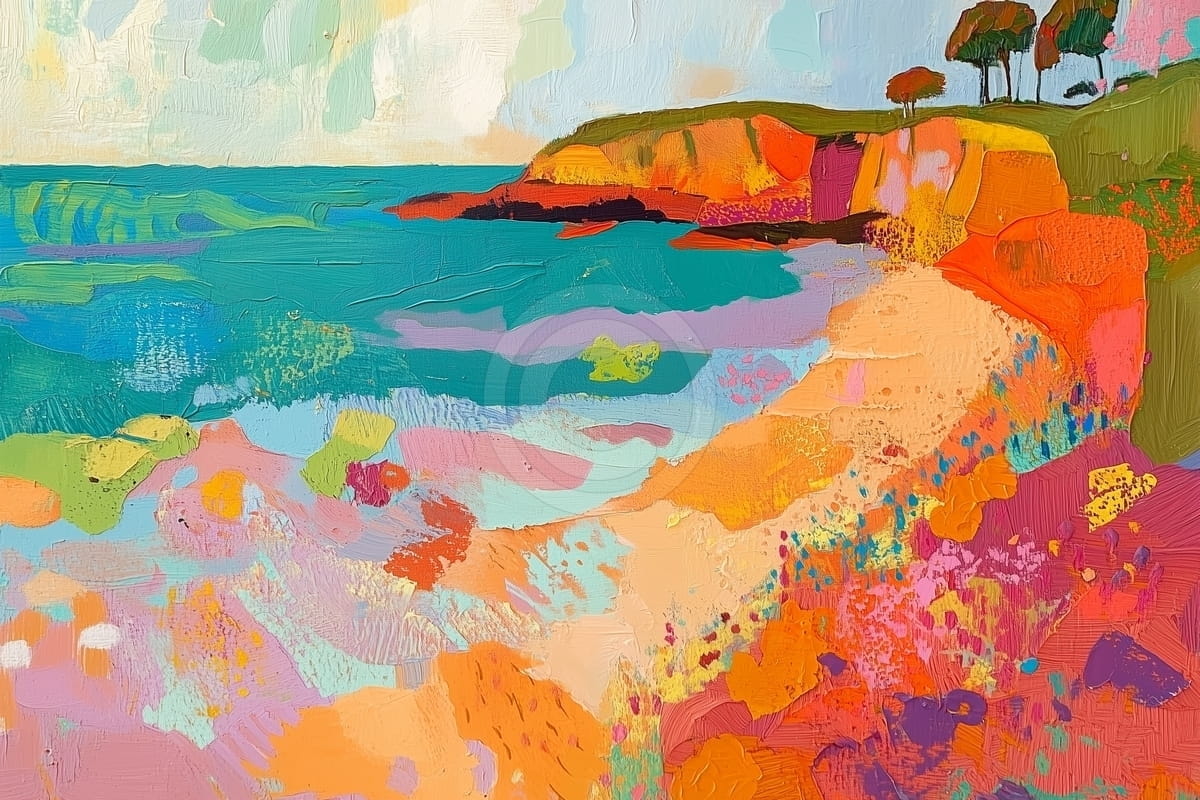
Near-abstract landscape wall art sits at the far end of the spectrum, where the distinction between "landscape" and "abstraction" becomes genuinely a matter of degree rather than category. Coastal scenes are particularly common here — the horizon line gives just enough structure for the eye to read "sea" and "sky," while everything else dissolves into color and gesture. These pieces are ideal when you want the energy and openness of abstract wall art but still want a tether to something recognizable, giving the piece a slightly more grounded, less purely conceptual feel than full abstraction.
Choosing where on this spectrum to shop matters as much as choosing a subject. A loosely impressionist forest print and a near-abstract coastal canvas will do very different things in the same room, even though both are technically "modern landscape art."
Why Color Does More Work Than Detail
One of the defining features of modern landscape canvas art — across the whole spectrum above — is that color carries far more of the emotional weight than detail does. A traditional landscape artist spent enormous effort getting the texture of bark right, the correct number of branches, the believable distance between foreground and background. Modern landscape wall art often treats those details as optional, even beside the point, and instead asks: what color makes this place feel the way it's supposed to feel?
This matters practically when you're choosing art prints for a room, because it means modern landscape pieces tend to read first and foremost as color statements before they read as "pictures of a place." A sunset-toned landscape print will warm a room the way a sunset-toned abstract canvas would — the literal subject matter is almost secondary to the color temperature it introduces. This is genuinely useful information when shopping: think about the color a room needs before you think too hard about whether you want "mountains" or "coastline" specifically. The emotional and decorative effect of a warm golden landscape print and a cool blue-toned one will differ far more than the difference between two prints of the same color palette but different subjects.
Canvas as the Natural Medium for Modern Landscape Art
The case for canvas art prints over framed paper, metal, or acrylic applies to modern landscape wall art just as strongly as it does to abstraction, for many of the same underlying reasons, plus a few specific to this genre.
Texture matters enormously for landscape canvas art because so much of the genre's appeal lives in visible brushwork — the loose, confident strokes of an impressionist-leaning print, or the textured layering that gives a near-abstract coastal piece its sense of depth. Canvas preserves that surface quality in a way flat paper simply cannot; a giclée print on canvas retains a visible weave that catches light and shifts subtly with the viewing angle, echoing the texture of an original painted surface far more convincingly than a glossy print under glass.
Scale is the second consideration, and it matters more for landscape wall art than it might for other genres, because this kind of art print often benefits from size in a way that flatters the subject. A large-format forest or coastal canvas allows the eye to enter the piece the way it would enter an actual view — at smaller scales, the same composition can feel cramped or like a postcard rather than an environment. Canvas handles large formats more gracefully and lightly than glass-faced alternatives, which is part of why it has become the default medium for landscape art prints meant to anchor a wall.
Finally, giclée printing's wide tonal range matters specifically for landscape color work. The subtle gradients in a sky at dawn, the gradual shift from warm to cool tones across a treeline, the layered depth of a coastal piece — all of these depend on fine tonal control that standard printing methods compress and flatten. Giclée reproduction on canvas keeps that range intact, which is often the difference between a landscape art print that feels atmospheric and one that feels merely printed.
Placing Modern Landscape Canvas Art in the Living Room
Modern landscape wall art tends to be more forgiving than abstract art when it comes to placement in a living room, simply because it carries an inherent sense of "view" — a window-like quality that orients the eye even from a distance. That said, a few principles still apply.
Scale to the wall, not just the sofa. Because landscape art prints often function almost like a window onto a scene, undersizing them breaks the illusion more noticeably than it would for an abstract piece. A landscape canvas that's too small for its living room wall reads as a framed photograph rather than an immersive view; a generously scaled one reads as an extension of the room itself.
Consider sightlines, not just wall space. Landscape wall art benefits from being visible from where people actually sit and linger in the living room — the sofa, an armchair, the spot where conversation happens — since part of its appeal is the slow, repeated act of looking into it, the way you might glance out an actual window. Placing a landscape print where it's only seen in passing wastes much of what makes the genre work.
Pair warm and cool tones deliberately. Because color carries so much weight in this genre, think about whether you want the piece to warm a room (autumn, sunset, golden-hour palettes) or cool it (coastal blues, forest greens, dawn grays) before settling on a specific canvas art print. The subject matter is almost secondary to this decision.
Final Thoughts
Modern landscape wall art occupies a genuinely useful middle ground for the contemporary living room — recognizable enough to feel welcoming and grounded, reinterpreted enough to feel current rather than nostalgic. Whether you're drawn to the loose warmth of impressionist-leaning art prints, the crisp simplicity of geometric, stylized canvas art, or the near-abstract dissolve of a coastal horizon, the underlying appeal is the same: nature, seen through a contemporary eye, freed from the obligation to simply document and given room instead to say something about color, mood, and feeling.
For anyone who wants to see this range in practice — from the softened palettes of impressionist-leaning forest prints to the simplified geometry of stylized autumn canvas art — browsing a dedicated modern landscape wall art collection is a useful way to get a feel for how differently "landscape" can be interpreted in canvas art prints before choosing the piece that's right for your own space.